
Slob with a blog. Vicariously join me on my movie viewing adventures! Visit my blog here: http://jinglebonesmovietime.blogspot.com
297 posts
MURDER SHE SAID (Dir: George Pollock, 1961).

MURDER SHE SAID (Dir: George Pollock, 1961).
The first in a series of four MGM-British murder mysteries staring the incomparable Margaret Rutherford as Agatha Christie’s amateur sleuth Miss Marple.
Adapted from Christie's 1957 novel '4:50 from Paddington', Murder She Said sees Miss Marple witness a murder on a passing train. When the police won't listen to her, she takes matters into her own hands. Surmising that the body must have been deposited at the nearby Ackenthorpe Hall, she poses as a maid and finds employment at the stately home. Here she is perfectly placed to investigate the family and staff who would all appear to have motive for murder. Meanwhile the killer racks up a few more bodies.
This has to rank as among the most lighthearted Agatha Christie adaptations, taking a far more comedic approach than usual.
Christie was reportedly unhappy with the casting of Margaret Rutherford. In fairness her Miss Marple is nothing like the one in the novels, but she attacks the part with such gusto and good humour that it is hard not to love her in the role. An invention of the movie is Miss Marple’s loyal companion and romantic interest Mr Stringer, played by her real life husband Stringer Davis. This relationship is a nice addition to the story which also serves the practical purpose of allowing Miss Marple to convey some necessary exposition to the audience.
Excellent support is offered, especially from James Robertson Justice as the bedridden family patriarch and keep an eye out for future Miss Marple Joan Hickson further down the cast.
In its depiction of a quaintly dated post-War Britain, Murder She Said seems both of its time and oddly timeless. Christie purists may carp that too many liberties are taken with the original text and no one would suggest that this is a definitive telling. But to criticise it as such would be kind of missing the point. Murder She Said is enormously entertaining with superb performances from some British acting legends. It is all very silly, but also very funny and with some genuine moments of suspense. An excellent, infectious score by Ron Goodwin adds to the fun.
Visit my blog JINGLE BONES MOVIE TIME for a longer, more in-depth review of Murder She Said. Link below.

-
 thegoldenageofrocknroll liked this · 5 years ago
More Posts from Jingle-bones

MURDER MOST FOUL (Dir: George Pollock, 1964).
MGM’s third outing for Agatha Christie’s amateur sleuth Miss Marple, with the incomparable Margaret Rutherford in the title role.
Investigating the murder of a blackmailer, Miss Marple bluffs her way into theatrical troupe the Cosgood Players, with whom the victim has a previous association. The old girl knows she is on the right track as more troupe members are disposed of. Anyone of the players has possible motive for murder, and Miss Marple is soon in danger herself as the killer gets wind of her snooping.
As with the previous series entry Murder at the Gallop, this movie is based upon a novel featuring Christie’s Belgian detective Hercule Poirot, in this instance her 1952 novel Mrs McGinty’s Dead. As before, Poirot is elbowed out the picture to make way for Miss Marple.
Once again Rutherford attacks the role of Miss Marple with relish! While nothing like the literary incarnation, she injects the role with such goodnatured bluster that its impossible not to love her interpretation. A strong supporting cast of Brit acting legends adds to the fun. Returning from previous adventures are Charles Tingwell as the long suffering Inspector Craddock and Rutherford's real life husband Stringer Davis as Miss Marple's chaste love interest Mr Stringer.
As with other titles in the series, Murder Most Foul is not necessarily one for Christie purists. Great liberties are taken with the original, not just the recasting of the lead character. However, the movie is a lot of fun. Director George Pollock skillfully judges the overt comic tone with the more serious business of murder. There are genuine thrills to be found as the mystery unfolds to a neatly suspenseful, not too obvious climax.
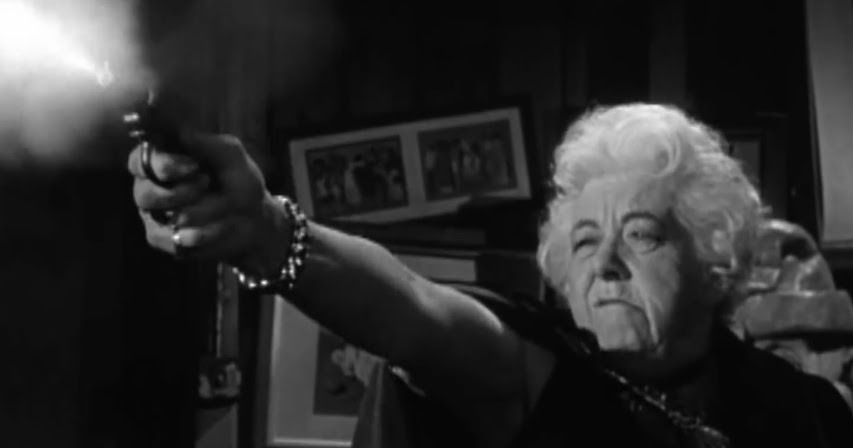
In truth, Murder Most Foul differs little from the two previous outings. But happily, what worked before works again and the formula still feels surprisingly fresh. Unfortunately Miss Marple doesn't delight us with her twist again, or any other fad dances for that matter. But as compensation she does perform a priceless rendition of Robert W Service's poem The Shooting of Dan McGrew, which alone makes the movie worth a watch!
A longer, more in-depth review of MURDER MOST FOUL is available on my blog JINGLE BONES MOVIE TIME! Link below.

KLAUS (Dir: Sergio Pablos, 2019)
Just when you think you have seen all the Santa origin stories you care to, along comes Klaus. Netflix’s first original animated feature film, Klaus made its debut on the streaming service in November 2019; an early gift for the festive season. Produced by Sergio Pablos Animation Studios, it is the directorial debut of studio head Pablos, the co-creator of Universal's highly lucrative Despicable Me franchise.
Incompetent postman Jesper (Jason Schwartzman) is sent by his Postmaster General father to establish a post office in the remote northern isle of Smeerensburg. On arrival he finds a divided community, engaged in a bitter feud, who barely speak to each other, let alone send mail. Determined to succeed he seeks out each town member to extol the virtues of the postal service, including Klaus (J K Simmons), a mysterious, solitary figure with a workshop full of toys. The pair team up to distribute the toys to the unhappy Smeerensburg children, creating some new Christmas traditions along the way.
Klaus is as warm and heartfelt as you would expect a Christmas movie to be. Sure, it is sentimental, but never slushy and with genuine pathos in Klaus' backstory. Its distinctive visual style and expressionistic use of colour help make it one of the most visually pleasing animated features in recent years; the 2D animation combines the slickness that audiences would expect of a modern animated feature with a cartoony style reminiscent of the Mid Century Modern stylings of the UPA animation studios.
While Klaus does cover some similar ground to the Rankin/Bass TV favourite Santa Claus Is Comin’ to Town (Arthur Rankin Jr & Jules Bass, 1970), in all other respects it is easily the most imaginative take on St Nick's early years for sometime.
In a year where cinema release schedules have been dominated by animated sequels, first time director Sergio Pablos has crafted a movie which feels fresh and original, yet reassuringly tradition. It is arguably the most satisfying Christmas movie of the decade and seems destined to become a holiday classic.
Visit my blog jinglebonesmovietime.blogspot.com for 100+ movie reviews! Link below.

THE HOLLY AND THE IVY (Dir: George More O'Ferrall, 1952).
It has now been a few weeks since I watched this movie and I appear to have misplaced my notes. So, please forgive me for a review which is even lighter on insight and heavier on vague observances than usual!
Based on a play by Wynyard Browne, The Holly and the Ivy relates the story of a Christmas family reunion of the Gregory family, the patriarch of which is a seemingly stuck in his ways, traditionalist village pastor (Ralph Richardson); resented by his grown up family, who feel he has neglected them in favour of his parishioners. Tensions rise and family secrets are revealed before the expected reconciliation on Christmas morning.
A Christmas movie that previously flew under the radar, the reputation of The Holly and the Ivy seems to have grown in recent years. With its scintillating scandals and family feuds it is little more than the stuff of soap opera, but it is high class soap opera at that. Director George More O'Ferrall handles the potentially melodramatic subject in a low-key, restrained fashion, eliciting natural, believable performances from his cast.
At age 50, Ralph Richardson is a little too young to fully convince as the aged Reverend Gregory. It is an otherwise great performance, but the role would undoubtedly have benefited from the casting of an actor of more maturity. As his daughters, Celia Johnson and Margaret Leighton are the real standouts. Both convey their individual personal trauma with empathy and sensitivity. In an early appearance for the actor, the great Denholm Elliott also impresses as the alcohol dependent son.
The Holly and the Ivy offers little that hasn't been seen in countless other family dramas; its situations the now familiar tropes of formulaic 'Movie of the Week' features. Yet it is told with a sensitivity generally missing from such made for TV movies. It boasts a superior cast and strong direction from O'Ferrall. It also benefits from a warm nostalgia that tempers the sensationalist aspects of the story. While perhaps not quite a top drawer festive feature, it is a minor Christmas classic nonetheless.
100+ movie reviews now available on my blog JINGLE BONES MOVIE TIME! Link below.


BEYOND TOMORROW aka BEYOND CHRISTMAS (Dir: A Edward Sutherland, 1940).
My quest for obscure vintage Christmas movies has arrived at Beyond Tomorrow, a curious little movie with a somewhat convoluted plot.
A trio of wealthy businessmen (Harry Carey, C Aubrey Smith and Charles Winninger) play matchmaker to a teacher (Jean Parker) and a misplaced cowboy (Richard Carlson). When the three are tragically killed in a plane crash they return as ghosts to watch over the couple whom they have left a significant inheritance.
Beyond Tomorrow is one of a handful of Hollywood movies of the era to deal with themes of spirituality and guardian angels; notable examples include Here Comes Mr Jordan (Alexander Hall, 1941) and It's a Wonderful Life (Frank Capra, 1946). Unfortunately this movie is nowhere near the caliber of those classics.
Although relatively short, at roughly 80 minutes, I found it a chore to watch. It's early scenes, centered around the holiday season are easily its best. However the film soon descends into hollow sentimentality and mawkishness, with Adele Comandini's screenplay lacking the dramatic strength to overcome the corny and frankly odd premise. The 'B' movie is also lacking star talent, although Richard Carlson later would make an impression in Universal's late period monster flick Creature from the Black Lagoon (Jack Arnold, 1954). A bigger name would certainly have lent the movie a little more cache but, to be honest, I think it would do little to help either the pedestrian script or A Edward Sutherland's workmanlike direction.
I also feel this movie was slightly miss sold, as only its first third is festive. In a shameless yuletide cash grab the movie has latterly been marketed as Beyond Christmas. Cynical though this may be, the title is actually more accurate as much of the feature does, indeed, take place after Christmas!
I am a sucker for a decent Christmas film and Golden Age Hollywood is my favourite era of filmmaking, but this turkey of a movie did nothing for me. By all means worth a watch for the curious. Just don't expect it to fill you with Christmas joy.
Check out my blog JINGLE BONES MOVIE TIME for 100+ movie reviews! Link below

MURDER AT THE GALLOP (Dir: George Pollock, 1963).
Following the success of Murder She Said (George Pollock, 1961) aging amateur detective Miss Marple returns to investigate the death of the elderly Mr Enderby, supposedly frightened to death by a cat. Eavesdropping at the reading of Enderby's will, where his estate is divided between four family members, Miss Marple's suspicions are confirmed when the deceased's sister Cora suggests that the old man was murdered. When Miss Marple visits Cora to question her, she finds the sister too has been murdered. Deciding to investigate further, Miss Marple books herself a holiday at The Gallop Hotel and Riding School, an establishment run by Enderby's nephew Hector and the other surviving heirs.
The second of MGM’s Miss Marple movies was the first not to be based upon a Miss Marple novel. Rather, Murder at the Gallop is based upon Agatha Christie’s 1953 novel 'After the Funeral', which featured her other most famous creation, Belgian detective Hercule Poirot. Poirot is nowhere to be found in this adaptation in which he is supplanted by Margaret Rutherford’s bluffly brilliant interpretation of Miss Marple. Rutherford's real life husband Stringer Davis returns as loyal companion Mr Stringer, as does Charles Tingwell as the weary Inspector Craddock. Standout among the supporting cast is Robert Morley; his excellent comic turn as Hector Enderby threatens to steal the movie from Ms Rutherford. The quality cast also features neat performances from acting legends Flora Robson and Finlay Currie.
As with Murder She Said, the movie paints a picture of a quaint post-War Britain that never really existed and must have seemed archaic to audiences in the so-called 'swinging' sixties. But I feel this is kind of the point. The movie is very tongue-in-cheek and never takes itself too seriously; gently mocking genteel middle England, while at the same time romanticising it.
Again, this maybe not be an adaptation for Christie purists, but like the previous movie it is a lot of fun. There are some genuine moments of suspense amongst the jollity and Miss Marple even does the twist. What's not to love?
100+ movie reviews, including MURDER SHE SAID, available on my blog JINGLE BONES MOVIE TIME! Link below.