
20 something he/him | maker | micromobility advocate | psyched about perishing in the coming Climate Wars | DNI if you say 'cya l8r boi' to sk8r bois
26 posts
**SUMMER PRO TIP**
🔥🔥 **SUMMER PRO TIP** 🔥🔥
It's not the heat that gets you, it's the burning fury of knowing that something could be done about it, but the systems of power that govern us choose self destruction instead
-
 albadew liked this · 2 years ago
More Posts from Comingsoon2aroadsideditchnearyou
@sapphicsclub

Lmao
Why Capitalism Needs Infinite Growth to Survive
Or, 'Even The Goddamn Money Is Privately Owned '
So, you know how capitalism apologists always say that we need a high growth rate in order to ensure high standards of living? Didja ever notice how they don't actually give a shit and a half about the magnitude of resources people are able to access, only that the rate of change is positive? There's a structural reason for that. It's a dogshit one, but like, it's pretty influential.
It starts with Fractional Reserve Banking. Been around for a while, basically ever since paper money was invented. When a bank takes a savings deposit, it can lend most of that deposit back out to someone else. The person who takes out the loan will spend the money on something, and the person who receives the money will put it in their savings account, and the cycle repeats.
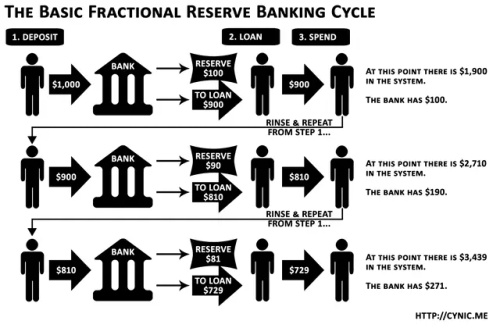
The reserve requirement in the US is 10%, which means that through this multiplier effect, the commercial banking system can expand the money supply printed by the government by up to a factor of 10x. In other words, ~90% of the money in circulation is privately owned, and crucially, it carries interest.
So, almost every dollar out there needs to get paid back to a lender, with some extra dollars sprinkled on top (as a treat). This is only possible if there is always more money in the future than there is in the present, in order to make up the missing difference.
This means capitalism is always operating in some mixture of three states:
1. The increased flow of money is spent on an increased flow of stuff, which is growth.
2. The increased flow of money is spent on the same amount of stuff, which is inflation.
3. The flow of money does not increase, so the loans cannot be repaid, so the banks crash and pull the plug on the money printer and now nobody has permission to do anything anymore and the entire system crashes and everything is terrible but it can probably be fixed with austerity guys, I promise, just one more public service cut, it'll fix everything this time, trust me bro
The State can come in and print a whole bunch of money to shift the economy from situation 3 to situation 2, but you can't print more resources. That requires pulling a bunch of energy and materials out of the ground. And so they pillage the Earth, and they lie about trying to cut back in the future, and they greenlight new fossil projects, and they pillage even faster, and they profit.
Capitalism can often feel insurmountable, but part of that is because, ever since World War 2, there have been easily extractable deposits of petroleum that have let the system constantly accelerate to insane levels of material throughput. That won't last forever. Fossil fuels and mineral deposits get harder to extract as time goes on. And every time the extraction system has even the slightest hiccup, capitalism reveals itself to be as fragile as a shark, choking to death as soon as it stops swimming.

PICTURED: How energy and mineral resource depletion built up to trigger the 2008 financial crisis, and radicalized an entire generation
Inaugural post, I’d like everybody to internalize that the Netherlands did not rise out of the primordial soup as a cycling paradise.
In fact in the 1950s and 60s we were pretty busy making plans to roll highways through cities, looking at cars as the ✨ future ✨ and trying to follow America’s lead - including hiring American planners, some of whom advocated flattening entire historic neighborhoods to do so (like plan Joniken). In the 1970s Amsterdam was deciding whether to rebuild a historic neighborhood that had been partially demolished to build the new subway or build a four lane road there, and the road plan was defeated by just one vote (crucially the wife of one of the councilmembers who voted to restore the old street layout was about to have her baby, but he stuck around long enough for the vote).
In the 1970s many Dutch streets were what I’d graciously term car gutters, cluttered end to end with traffic, and the number of traffic deaths kept rising, peaking in the early 1970s with about 3300 deaths - 400 of whom were children. There was a growing “damn we can’t keep living like this” realization

Amsterdam traffic in the 70s
People began protesting and advocating for change, including the admirably bluntly named “stop de kindermoord” (‘stop the childmurder’) campaign, among many others. These campaigns did stuff like block streets and hold dinner parties there, holding demonstrations and illegally painting lanes on the road at night, but also by identifying traffic bottlenecks and producing a huge report with practical solutions. It was a constant struggle and they had to fight for every street, but they got results and their progress is reflected in the official standards that all streets have to meet, which over the course of a few decades of regular street maintenance and redesigns meant the entire country steadily became bike friendly. The effects can be seen in the statistics (below are traffic deaths per year, divided by type of vehicle, red is cars, light blue is bikes, dark blue pedestrians). The proportion of young children who died in traffic also fell sharply. Don’t let yourself be fooled into thinking the Netherlands just emerged as a place with a cycling culture out of nowhere - people fought tooth and nail to get the cars to fuck off


Pure carbrain propaganda. Jeff B*zos only mumbles to himself about the toupee, he doesn't actually ask people about it.